
Growing on Paper, Hollowing Out in Practice
Why West Ashley's Boom Is Squeezing Out Its Small Businesses
West Ashley is not struggling. By every headline metric, it's thriving. The area is one of the fastest-growing parts of the Charleston region. Home prices are climbing and the redevelopment of Ashley Landing alone represents what city leaders call the largest single investment in West Ashley since Citadel Mall — a 31-acre, mixed-use project anchored by Publix with roughly 240,000 square feet of new retail and restaurant space, plus hundreds of new apartment units and green community space breaking ground nearby. Add in the MUSC expansion into the old mall site, new roundabouts and infrastructure spending, and thousands of new rooftops pushing out past I-526, and you get a neighborhood with every sign of momentum.
And yet, a local hardware store - the kind of place that exists specifically because a neighborhood has staying power - has shut its doors after more than a decade.
That contradiction is the story, not a footnote to it. And it's worth being precise about why it's happening, because the explanation people reach for first - "not enough customers," "everyone shops on Amazon now," "people just need to shop local more" - doesn't hold up. A business can have loyal customers, healthy foot traffic, and a full register, and still lose its lease. Growth and small business survival are not the same variable. Too often growth actively works against small, local-indie businesses unless a community intentionally builds in protections for them. Charleston hasn't done so yet, and it's showing.
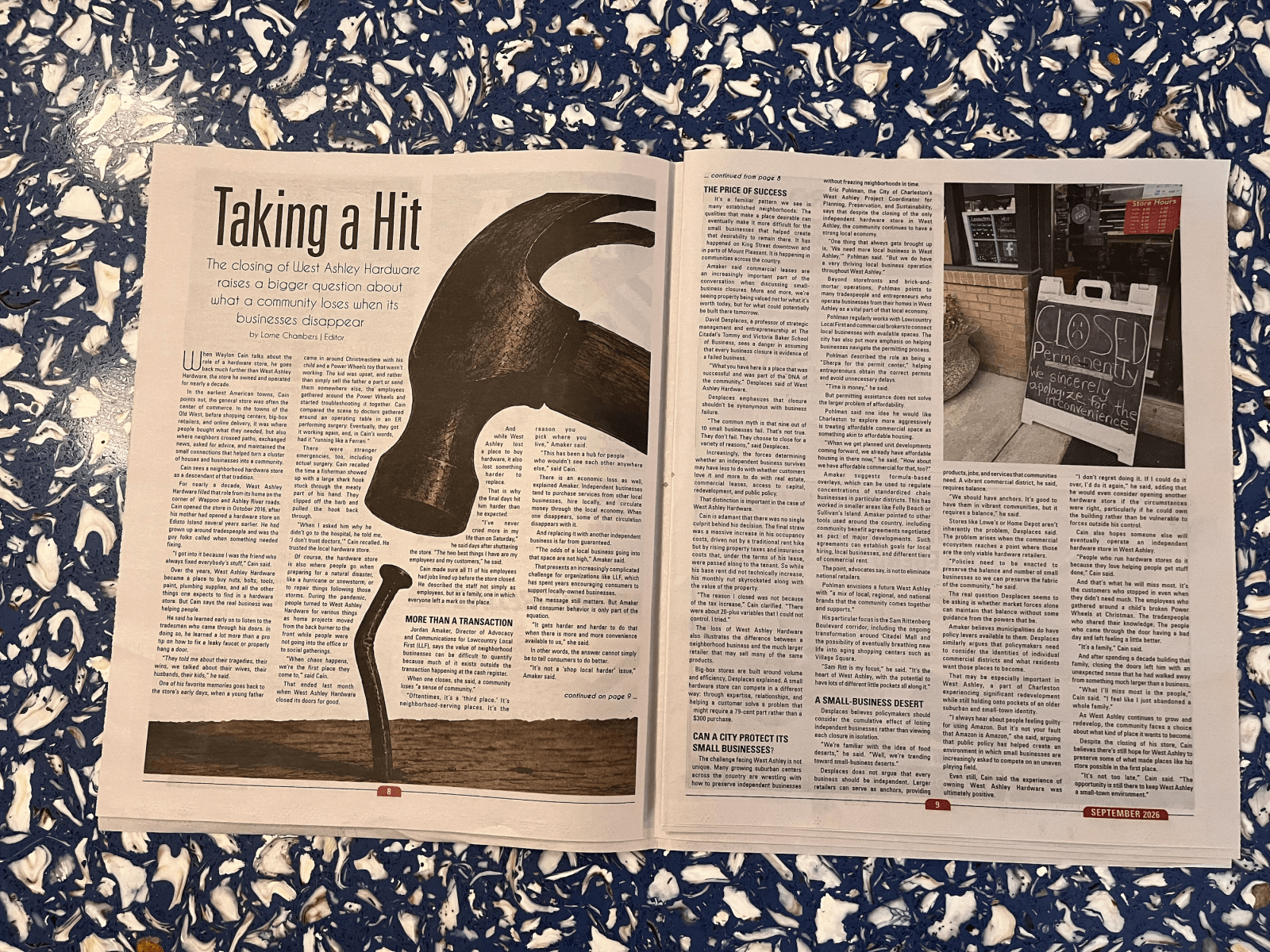
Read our opinion as shared in the September 2026 issue of West Of.
Why "shop local" alone can't fix this
"Buy local" campaigns, like the very ones we've run for nearly two decades now, aim to convince enough people to spend their money at the hardware store instead of the big box, with hopes that the little guy survives in the end. That logic works when a business is genuinely losing customers. It does nothing when the threat isn't the number of customers - it's the terms of the lease.
In commercial real estate, rent is very often decoupled from what a business can actually generate in revenue. A landlord doesn't set rent based on what's sustainable for a hardware store; they set it based on what the “market” - aka the highest bidder who is too often a regional or national chain, or a redevelopment plan that wants that parcel for something else entirely - will bear. When that number rises faster than a small business tenant's margins can absorb, it doesn't matter how loyal the customer base is. You cannot out-shop a rent increase.
The deeper issues
1. Commercial leases offer almost no protection to tenants. Unlike residential renters, commercial tenants - especially here in South Carolina - have essentially no statutory protections against rent increases, non-renewal, or short-notice displacement. A lease can lapse after 10, 15, or 20 years of a business building goodwill in a location, and the landlord owes that tenant nothing beyond the terms of the expired lease. There's no right of first refusal, no required notice period tied to tenure, no rent-increase caps. The tenant who invested a decade building a customer base has less leverage at renewal than a new national chain walking in with a corporate real estate department and a term sheet. (Did you know Lowcountry Local First offers free Commercial Space Advising for first-timers looking for brick-and-mortar? This is offered thanks to a generous network of experts who give of their advice from areas such as real estate, development, architecture, permitting/zoning, legal/lease support, and more. Learn more here and send someone our way BEFORE they sign that lease.)
2. Redevelopment economics favor credit tenants, not local ones. When a shopping center like Ashley Landing gets rebuilt, the math that developers and their lenders run isn't about who serves the neighborhood best. The mat is about "credit tenants": chains with strong balance sheets that banks will underwrite construction loans against. A regional or national grocery anchor or formula restaurant reduces a lender's risk. An independent hardware store, however beloved, doesn't carry the same weight on a balance sheet. The financing system that makes large-scale redevelopment possible is also the system that filters out small, local ownership by default.
3. Land speculation raises the floor under everyone. As an area is publicly identified as "the next place" - typically through master plans, mall redevelopment, hundreds of millions in announced investment - the land and buildings get priced not for their current use, but for their future potential use. A landlord holding a strip of retail near a corridor slated for redevelopment has every incentive to raise rent toward what a future denser, higher-value project could support, even while the current building still houses a hardware store. Growth announcements themselves become a driver of rent increases well before a single shovel hits the dirt.
4. Rising costs stack on top of rent. Property tax reassessments (triggered by rising area values), insurance premiums, and triple-net lease structures (where tenants also cover taxes, insurance, and maintenance on top of base rent) all compound. A landlord's costs rise with neighborhood investment, and those costs get passed straight through to the tenant, regardless of that specific business's sales volume.
5. There's no exit ramp for aging ownership. Many long-running local businesses are owned by people nearing retirement with no succession plan, no capital to pass the business to an employee or family member, and no institutional buyer interested in a hardware store versus the real estate it sits on. When the owner is ready to step back, selling to a developer or simply closing is often the only option on the table — even when the business itself is healthy. (We dig this business transition support program out of Indiana. Where would this best fit in the Lowcountry?)
None of these five forces have anything to do with customer demand. They're upstream of it. “Buy Local” campaigns have a place and purpose but cannot be the only lever being pulled for the sake of small business. It’s why Lowcountry Local First has intentionally paired our work to drive public support to local businesses with tactical support to succeed and advocacy to address these bigger issues and opportunities. To change the narratives being told and help the community realize its power to shape their neighborhoods.
What actually moves the needle: policy and developer accountability
Cities that have taken small-business displacement seriously haven't relied on consumer goodwill. They've changed the rules governing commercial real estate and public investment. Here are some ideas with real precedent, scaled to what a city like Charleston (or North Charleston, Mount Pleasant, Summerville, etc.) could pursue today:
Local-ownership set-asides tied to public approvals. Any project that needs a rezoning, a variance, TIF financing, or other public incentive (like the redevelopments now moving through West Ashley) can be required to reserve a defined share of retail square footage (commonly 15–25% in comparable programs) for local, independently-owned, non-formula businesses, often at below-market or graduated rent. If the public is enabling a project's economics through approvals and infrastructure, the public can attach conditions.
A local commercial tenant "right to negotiate" or right of first refusal. Legislation modeled on New York's proposed Small Business Jobs Survival Act would guarantee existing tenants a formal renewal negotiation period and, in some versions, the right to match a competing offer before a landlord can hand a space to a new tenant. It doesn't cap rent forever — it does give a bit of leverage at renewal time.
A commercial rent stabilization pilot for small, independent tenants. Several cities (Seattle has studied this; San Francisco enacted eviction-related protections) have explored capping annual rent increases specifically for small commercial tenants below a certain square footage or employee count, leaving room for market-rate leasing on larger, chain-scaled spaces while protecting the smallest, most vulnerable tenants.
Formula-business caps in designated corridors. The City of Folly Beach, Town of Sullivan’s Island and dozens of other cities across the country have adopted zoning policies to limit the density of chain/formula retail in specific commercial districts through conditional-use permitting. Applied selectively along corridors like Savannah Highway or Maybank Highway, formula business ordinances could preserve room for unique, independent retail even as redevelopment proceeds. These have stood up in court against property rights concerns as it doesn’t limit based on tenant ownership - the zoning tool simply creates a public-input process that can protect the unique character of the corridor.
A small business preservation fund with zero- or low-interest tenant-improvement and relocation loans. Publicly or philanthropically capitalized, this can help an existing business absorb a lease renewal spike, retrofit a new space, or bridge a gap during redevelopment displacement, filling the financing gap that steers redevelopment economics toward chains in the first place.
A legacy/local business registry with technical and financial support. Modeled on San Francisco's Legacy Business Program, this formally recognizes long-tenured local businesses and channels grants, succession planning assistance, and priority consideration in redevelopment leasing toward them. These often work best with governments partnering with local organizations like Lowcountry Local First that can support the application review process and tactical support elements. Sign us up!
Community benefit agreements as a condition of major redevelopment. For projects of Ashley Landing's scale, the city and developer can and should negotiate binding commitments such as local hiring, local leasing targets, affordable commercial rent tiers and more.
The time is now
The reason this conversation matters in West Ashley specifically is timing. Ashley Landing, the Citadel Mall/MUSC redevelopment, and the broader wave of investment moving past I-526 are still in active planning and negotiation, not locked in. Plan West Ashley, the city's own master plan, already names "revitalizing obsolete auto-centric commercial areas" as a goal. This is the time to attach local-ownership requirements, not after the leases are signed and the anchor tenants are chosen.
A neighborhood can absorb new investment and keep its local hardware store. Those aren't in tension by nature. They're only in tension when nobody writes the rules that make room for both. Right now, nobody has.
Tell us what you think! What resonates? What's too far of a stretch? Email me.